Last weekend was full of activity. I was helping out again in the Augustinian parish. This is the time of year when first communions and confirmations take place here. Just as in any parish this means that there is lots going on. In fact, the months of November and December are particularly busy in Panama because a lot of things coincide - First Confession, First Communion, Confirmation, Independence Day Celebrations, Advent, Christmas, and this is also the time of year that is most favoured for weddings (so I'm told).
Confessions were interesting - not because of the sins, but because of those confessing. First Communion here is given when children are approximately 11 years of age; Confirmation, when they are 18. This is such a totally different experience to Ireland that I found it to be quite striking. Firstly, the children for first communion, being that little bit older, are much more confident. They also have a much better capacity to understand at least the basics of what is involved in the celebration of Mass. Their confessions reflected this as it was very noticeable that they were able to think about their lives and the significant relationships in them.
Making confirmation at 18, when they are just preparing to leave school, instead of at 11 when they are just leaving it, is a totally different experience. These are no longer children - they are young adults. They also have the experiences, dreams, and challenges that you would expect young adults to have. Making confirmation for these young adults is not an automatic event. This is something that they have chosen - and they have to choose it for themselves.
Catechesis here is generally done in the parish, so those who wish to be admitted to these sacraments have to make quite an effort to make it to the celebration. Each one has to follow a course that lasts for 2 years (2 hours a week). The course is given by catechists who are volunteers in the parish. Those who don't complete the course, don't make their first communion or their confirmation. This is a very different experience from Ireland where all sacramental preparation is done in the primary school. This is very often done very well but I have always thought that there are two important drawbacks - 1) the catechesis is associated only with school and not with the parish. This means that once school is left behind, so, very often, is the catechesis; and 2) the time dedicated to the sacramental preparation is much greater when it is done in the parish. Another important advantage that I notice is that less emphasis is given to the actual celebration, and more to the learning - there is much less practising for the big day (if, indeed, there is any, because normally there isn't) and much more practising of their faith by going to Mass each week (a requesite), and by being involved in parish activities.
Of course, all is not perfect here either - Panama has the same problem that we have when it comes to those who have been confirmed - once they are confirmed they are rarely seen again in the church. However, it is true that there is a much higher index of participation in parish activities for young people in Panama than in probably any local church in Ireland.
On Sunday I was asked to preside at a First Communion celebration. This was a group from a religious run secondary school (run by the Franciscan Sisters of the Immaculate Conception) which means that this group didn't do their preparation in the parish but in the school - not, however, during the hours of lessons; catechesis is done after normal school hours. Like all of these celebrations there was a great deal of joy.
Some things that stood out for me during the First Communions - there was no disruptive noise from the congregation; most people in the congregation knew the responses to Mass and also the hymns; everybody arrived early; the children participated in all the moments of the Mass but without the "performance" element that can so often take over from the celebration itself. All in all a very interesting experience.
Tuesday, 17 November 2015

Friday, 13 November 2015
God Speaks Chinese Too!!!
Yesterday I took part in a programme on Radio Maria. This is the Panamanian branch of a movement
 which is world wide and which offers Catholic programmes to its listeners. Earlier this year, if I am not mistaken, Radio Maria began to broadcast in Ireland. This is not an entirely Marian radio station - it seeks to engage with issues such as spirituality, theology, family and social issues, as well as a broad variety of different current affairs programmes. Mass is broadcast on a daily basis for those who are housebound and there are also a number of reflections on the daily readings, christian living, and similar topics.
The programme that I was involved with is called: "God Speaks Chinese Too!". As the name suggests, this is a programme that caters for the needs of the Chinese community here in Panama. Here in Panama this is a very large community and very vibrant - many people are first or second generation Panamanians and still have family in China. Chinese is the favoured language of many of these people and, since there are many Catholics among their number, this programme goes some way to meeting their spiritual needs. There is also a Mass, twice a month in Chinese. Attempts have been made in the past to have a Mass every week, or perhaps even a Chinese parish here but the major difficulty has been the availability of a priest who speaks Chinese.
I was invited by Claudina Siu, one of the many people who attend Mass in the Augustinian parish who are of Chinese extraction. Obvoiously, I wasn't speaking Chinese, but I was invited to be interviewed to discuss, among other things, the differences I notice between the church in Ireland and in Panama, the work I am doing in the seminary, and also a little bit about the studies I have been able to do in the area of theology. The programme also involved me giving a Sunday reflection. The programme was being pre-recorded because I have class at the time of its transmission - it will be going out on next Thursday at 11am (Panamanian time) so if you want to tune in I'm sure you can find the details on Radio Maria Panama's website - a great chance to brush up on your Spanish and your Chinese!!!
Together with myself and Claudina was a lady who read messages in Chinese and also another lady who has links with the Chinese community here, who was the second interviewer. The programme lasted 50 minutes and while I expected it to be difficult to fill the time, it actually flew by.
I'm not sure what listenership Radio Maria has in Ireland but I do know that in Panama it is widely listened to. It is an important tool for the evangelisation effort of the Panamanian church and is also a great way for communities to be in touch with each other by knowing what each other is doing. They also have a very good Catholic newspaper here, called Panorama Católica - run by the only Irish priest resident in Panama (Fr. Sean Rooney, from Belfast). This is really well laid out and there is a section for each part of the country as well as current church events, catechesis, parish resources, and stuff for children.
All in all, very interesting to see the effective use being made of radio and printed media in a conscious effort to evangelise. There is probably much we could learn for application in the Irish church.
The programme that I was involved with is called: "God Speaks Chinese Too!". As the name suggests, this is a programme that caters for the needs of the Chinese community here in Panama. Here in Panama this is a very large community and very vibrant - many people are first or second generation Panamanians and still have family in China. Chinese is the favoured language of many of these people and, since there are many Catholics among their number, this programme goes some way to meeting their spiritual needs. There is also a Mass, twice a month in Chinese. Attempts have been made in the past to have a Mass every week, or perhaps even a Chinese parish here but the major difficulty has been the availability of a priest who speaks Chinese.
I was invited by Claudina Siu, one of the many people who attend Mass in the Augustinian parish who are of Chinese extraction. Obvoiously, I wasn't speaking Chinese, but I was invited to be interviewed to discuss, among other things, the differences I notice between the church in Ireland and in Panama, the work I am doing in the seminary, and also a little bit about the studies I have been able to do in the area of theology. The programme also involved me giving a Sunday reflection. The programme was being pre-recorded because I have class at the time of its transmission - it will be going out on next Thursday at 11am (Panamanian time) so if you want to tune in I'm sure you can find the details on Radio Maria Panama's website - a great chance to brush up on your Spanish and your Chinese!!!
Together with myself and Claudina was a lady who read messages in Chinese and also another lady who has links with the Chinese community here, who was the second interviewer. The programme lasted 50 minutes and while I expected it to be difficult to fill the time, it actually flew by.
I'm not sure what listenership Radio Maria has in Ireland but I do know that in Panama it is widely listened to. It is an important tool for the evangelisation effort of the Panamanian church and is also a great way for communities to be in touch with each other by knowing what each other is doing. They also have a very good Catholic newspaper here, called Panorama Católica - run by the only Irish priest resident in Panama (Fr. Sean Rooney, from Belfast). This is really well laid out and there is a section for each part of the country as well as current church events, catechesis, parish resources, and stuff for children.
All in all, very interesting to see the effective use being made of radio and printed media in a conscious effort to evangelise. There is probably much we could learn for application in the Irish church.
Thursday, 12 November 2015
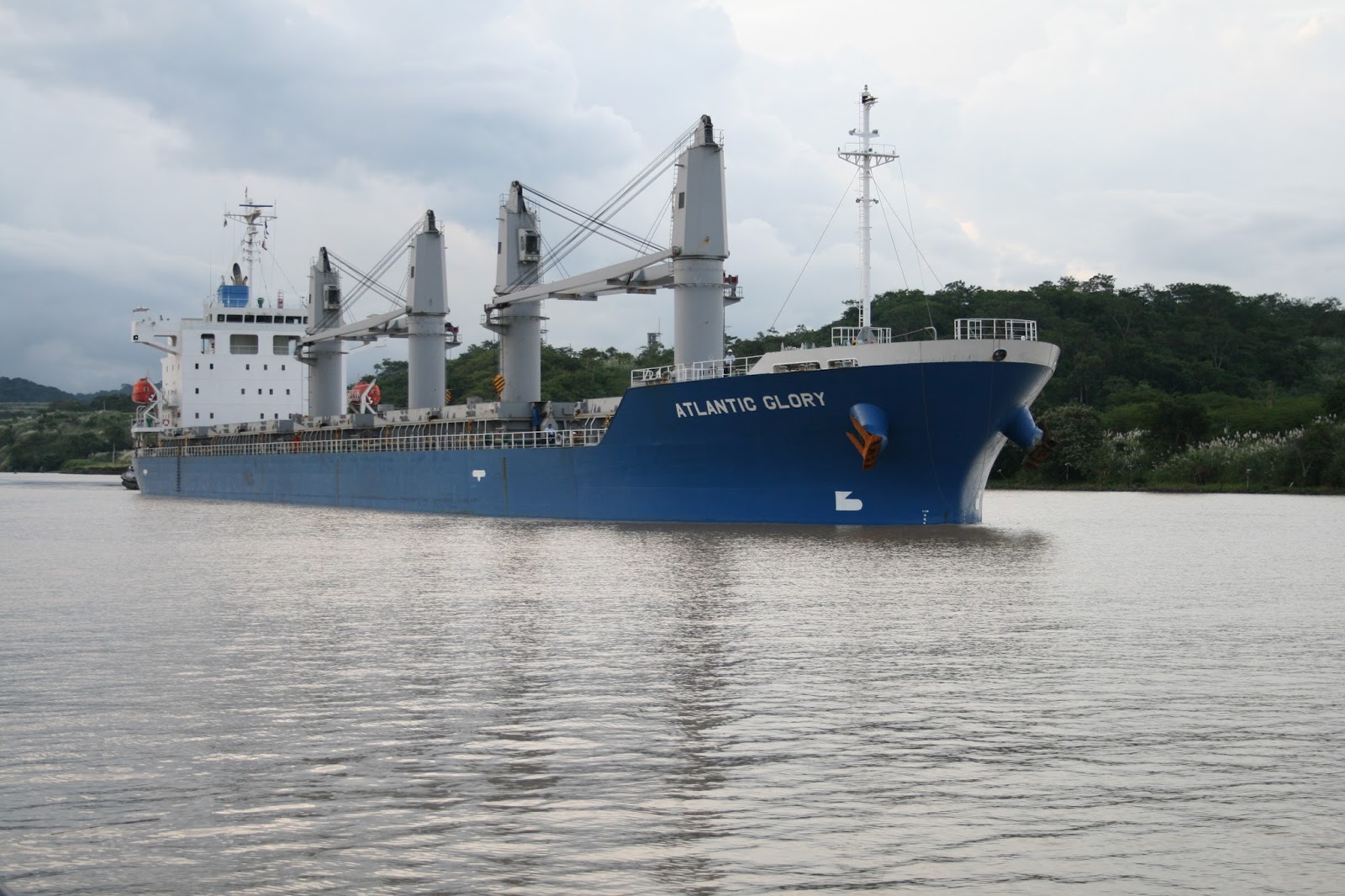
Working on the Panama Canal
As you can imagine, no trip to Panama can be
complete without a visit to the canal. This canal, often referred to as one of
the wonders of the world, is intimately connected with Panamanian life at many
levels – in fact, the income from the canal provides a significant part of
Panama’s GDP.
It really is quite an amazing operation. More than
10,000 people work on the canal which is open and working twenty four hours a
day and three hundred and sixty five days of the year; and, generally, they are
better paid than those who work elsewhere. At any one time there can be up to
100 ships waiting to pass through the canal (on both sides); and this is just
the large cargo ships – yachts etc are “squeezed” in with them. Ships book up
to five years in advance to be able to cross the canal and they are charged by
tonnage – large cargo ships can pay amounts between 250,000 and 300,000 dollars
a trip. This will give you an idea of the value of the cargo these ships are
carrying. A man working on the canal told me that some ships can have up to
20,000,000 dollars worth of cargo.
The canal has an average depth of 85 feet. When it
was opened it could accommodate any ship in the world. Now, with the advent of
super tankers, that is no longer the case. That is why the Panamanians are
currently building an extension to the canal – another channel which will accommodate
these larger vessels.
There are a number of ways to visit the canal – one (the
most normal) is to go to one of the lock gates and watch ships passing from the
viewing platforms. The other is a tourist ship that carries passengers from one
side of the country to the other, passing through the canal. I found a third
way. A lady in the Augustinian parish who works at the canal arranged for three
of us (myself, Fr. Edwin, and Br. Fabian) to spend the day on a working tug
boat on the canal.
There are 40 tugs that work on the canal. Each one
has a crew of four – a captain, an engineer, and two sailors. Each tug weighs
27 tonnes and has 6,000 horse power. Their job is to push, pull, guide and
steer the large ships through the canal and through the lock gates. We spent 12
hours on one of these and were with the crew as they worked away. It really was
a fascinating way to see the canal and a great way to understand how it works. We
were extremely privileged as this is not a “trip” that is open to the pubic
generally. It is something that is done from time to time but always as a treat
for “friends”. I think I should stress that we weren’t working, we were
watching the others work – the only way to do it!!! I think the photos give a
good idea of some of what we saw.
 |
| Centenary Bridge - from below |
 |
| Notice how tight a fit |
 |
| Logo of the Canal Authority |
 |
| The Lock Gates |
 |
| Centenary Bridge at Dusk |
 |
| Car Transporter |
 |
| Being guided by a tug just like "ours" |
 |
| Bringing Grain to Cuba |
 |
| Fr. Edwin giving the safety talk |
 |
| Lock Gates Closing |
 |
| Look at how full the ships are |
 |
| Only 4 inches to spare on either side |
 |
| View from the bridge |
 |
| The Captain |
 |
| Locomotives used to regulate the speed of the ships to a snail''s pace |
 |
| Fr. Edwin and Br. Fabian and some of the thousands of cranes |
 |
| "Our" Tug |
 |
| One of the Ships we Guided |
 |
| Getting lined up for the lock gates |
 |
| A Tug just like ours |
Wednesday, 11 November 2015
Independence Day
Last week was probably the biggest week of the year in Panama. Independence day is the 3rd of November but, at different times during the same week they celebrate different stages of independence: from Spain, from Colombia, and I'm not sure from what else. The there are the "gritos" (shouts) of independence - as each city got the news the shout went up. Obviously, in the days before internet, or even telephones, the message was carried by horseback and so different cities received the news on different days.
I suppose you could say that Panama became independent gradually, twice. Once from Spain and Colombia, and then again as the news of independence spread through the country.
Celebrations began on the 1st of November with the solemn burning of all the flags on public buildings. Like many Latin American and Central American countries, the flag is a very important symbol of the country and is treated with a great deal of respect. School children regularly swear their oath of allegiance to the flag promising to protect it and their country from any harm.
Celebrations are marked by very long parades in which civic institutions, schools and colleges all take part. This is taken very seriously and participants practice for months beforehand - honing their marching and band-playing skills. It is also a big time for families. Since everyone is off work (except a very unlucky few) it gives people the opportunity to travel back to their original home place and catch up with friends, family and relations.
The parades are real family occasions and are carried off with a great deal of panache and dignity. I'm told that there are also less ordered celebrations in neighborhoods where there is a lot of dancing and, by all accounts, lots and lots of drinking.
I didn't see much of the celebrations this year due a bug I picked up (the reason I haven't been on line very much lately) but I am told that they were a huge success.
One interesting thing to note is that while Panama has no army (since the overthrow of the military dictatorship of General Noriega) the police is, esssentially a paramilitary force. In fact, to see them around the time of the parades on the TV it is impossible to tell the difference between them and an army. Many of the people here at the seminary say that while there is no official army, there is a de facto one, within the police.
I suppose you could say that Panama became independent gradually, twice. Once from Spain and Colombia, and then again as the news of independence spread through the country.
Celebrations began on the 1st of November with the solemn burning of all the flags on public buildings. Like many Latin American and Central American countries, the flag is a very important symbol of the country and is treated with a great deal of respect. School children regularly swear their oath of allegiance to the flag promising to protect it and their country from any harm.
Celebrations are marked by very long parades in which civic institutions, schools and colleges all take part. This is taken very seriously and participants practice for months beforehand - honing their marching and band-playing skills. It is also a big time for families. Since everyone is off work (except a very unlucky few) it gives people the opportunity to travel back to their original home place and catch up with friends, family and relations.
The parades are real family occasions and are carried off with a great deal of panache and dignity. I'm told that there are also less ordered celebrations in neighborhoods where there is a lot of dancing and, by all accounts, lots and lots of drinking.
I didn't see much of the celebrations this year due a bug I picked up (the reason I haven't been on line very much lately) but I am told that they were a huge success.
One interesting thing to note is that while Panama has no army (since the overthrow of the military dictatorship of General Noriega) the police is, esssentially a paramilitary force. In fact, to see them around the time of the parades on the TV it is impossible to tell the difference between them and an army. Many of the people here at the seminary say that while there is no official army, there is a de facto one, within the police.
Monday, 9 November 2015
Normal Service Resuming
To those who follow this blog I apologise - last week I was in the Augustinian parish helping out and, unfortunately, I got some sort of bug which knocked me out. I am now on the mend and will begin posting again tomorrow
Friday, 30 October 2015
Teamwork - Watching the Ants
I have mentioned before about the fact that every inch of this country seems to be alive. Plants grow vigorously without any particular care being given to them. There also seems to be an endless supply of insects of various shapes and sizes.
Yesterday I came across a whole army of ants who were all carrying parts of leaves. It really is fascinating to see them all, each carrying something that is at least eight or nine times its own size. As one group goes in one direction with the leaves, replacements are endlessly scurrying in the other direction to collect even more.
This spectacle continued all day long, and continues again today. Quite an amazing display of coordinated effort!
One of the things that caught my attention is that the pieces of leaf were being carried right up the driveway of the seminary - a distance of approximately 300 yards!!! To carry the leaves all this distance the ants had to pass a whole array of plants of all types in which they seemed to have no interest at all - so what made them choose the particular leaves that they were carrying???
There was very definitely a smell of eucalyptus in the air so I was inclined to think that the leaves were obviously from a eucalyptus tree. However, having searched on Google, I have discovered that eucalyptus is actually used to repel ants, so that's another theory quashed!!!
I don't know exactly why they were doing it so I think I'll have to be content with watching the spectacle of this amazing coordinated task.
In the photos you will see the leaves - you will also see the ants but you will have to look harder; they are so small that it is hard to photograph them.


Yesterday I came across a whole army of ants who were all carrying parts of leaves. It really is fascinating to see them all, each carrying something that is at least eight or nine times its own size. As one group goes in one direction with the leaves, replacements are endlessly scurrying in the other direction to collect even more.
This spectacle continued all day long, and continues again today. Quite an amazing display of coordinated effort!
One of the things that caught my attention is that the pieces of leaf were being carried right up the driveway of the seminary - a distance of approximately 300 yards!!! To carry the leaves all this distance the ants had to pass a whole array of plants of all types in which they seemed to have no interest at all - so what made them choose the particular leaves that they were carrying???
There was very definitely a smell of eucalyptus in the air so I was inclined to think that the leaves were obviously from a eucalyptus tree. However, having searched on Google, I have discovered that eucalyptus is actually used to repel ants, so that's another theory quashed!!!
I don't know exactly why they were doing it so I think I'll have to be content with watching the spectacle of this amazing coordinated task.
In the photos you will see the leaves - you will also see the ants but you will have to look harder; they are so small that it is hard to photograph them.


Tuesday, 27 October 2015
Chicken with Rice or Rice with Chicken - A Varied Diet
Lots of people have asked me about the food here. Well, rice
is the staple diet and appears at two of the daily meals – midday and evening.
Normally the rice is white but it can be a different colour (and flavour, even
though the flavour doesn’t always come through). This evening, for example, the
rice had a faintly green colour which was due to it having been cooked with
celery. It was grand but I would not, personally, be in any particular rush to
have it again. However, I have had rice here cooked with coconut which was
quite nice; with chilli which was lovely; and with roasted almonds which was
really delicious. However, no matter how you might colour it, rice is always
rice. After one month here I could do with a break from it. I did have one day
since I came when I ate no rice, but only one.
Potatoes are served sometimes – in small amounts, as mash or
as chips, but they are still accompanied with rice. They don’t seem to consider
potatoes to be in any way, a substitute for the omnipresent rice.
Maize (Corn) is also very popular here. I don’t tend to eat it
as I find it to be very hard on the tummy. Most of the time it is not eaten as
we would eat it – either on the cob or as kernels. It is most often ground and made
into a sort of hard pancake which people here eat with great gusto.
Another thing made from corn is Chicha. Chicha is a word which
in Panama means fruit or vegetable juice of any kind – in other parts of South America it refers
only to a drink made from maize. Here, in Panama, that maize-based drink is
called Chicheme. Traditionally, and here I warn anyone with a sensitive tummy, it
is prepared in a most unusual way – the women of the family chew the maize
kernels into a pulp, then they spit the pulp into a bucket where it is allowed
to ferment. Once it has fermented the pulp is passed through a sieve and the
liquid that remains is the drink that people here enjoy so much – Personally, I
wouldn’t touch it with a barge pole.
The other, almost daily item on the menu here is chicken.
Dinner is normally either rice with chicken or chicken with rice. These are not
the same thing!!! Rice with chicken is rice with pieces of chicken mixed
through it with some vegetables and seasoning; chicken with rice, on the other
hand, is a piece of chicken served on top of a bed of rice.
I’ll try to get some photos of the different dishes here and
share them with you.
By the way, it was so hot today that I was sweating even in the air conditioning!!!
Subscribe to:
Posts (Atom)