As I write this post I am just after getting up out of bed on my last night here to spray insecticide in my room to try to do something about the mosquitos. The last two weeks haven't been bad but, for some reason, tonight they have returned. Now that I have sprayed the room I will have to wait for about an hour before I can go back to bed, otherwise I will be poisoning not only the mosquitos, but myself too.
I was already feeling sad about leaving tomorrow (today really), but now I am really feeling sorry for myself.
I have packed everything that needs to be packed; finished up all of the marking and correcting; said my goodbyes; and also spent an inordinate amount of time trying to download a boarding pass, but that 's another story - now I have only one more Mass to say and then it's off to the airport for a ten hour flight to Madrid, a five hour wait there, and then on to Dublin where I should arrive some time on Monday evening.
Already there are plans for next year - to do some work with the priests of a number of dioceses on ongoing formation; to get involved with the Catholic University; and to increase the number of courses in the Lay Institute to three (the seminary will continue to mean teaching two or three courses, depending on who else is available).
A very worthwhile visit and I can honestly say that I have learned a lot from the wonderful people I have met while I was here.
Saturday, 13 April 2019

Thursday, 11 April 2019
Exams
I have been busy over the last few days with students, both seminarians and in the Lay Institute, doing exams. I am really pleased that all students in the Lay Institute passed the exam without difficulty. This is particularly important since many of these people have had little contact with formal education and for some of them, this was the first time they had ever sat an exam - it is a big achievement that shouldn't be underestimated. The majority of these 60 students will now continue with the rest of the year's course and I hope to meet some of them again at other courses as they progress towards an eventual degree.
The seminarians, on the other hand, have not fared so well. Most of those who have done the oral exam so far have done well, but not all - we will be organising some sort of essay so that they can have another go via email after I have left Panama.
Exams will continue right up until Friday, and then I will leave on Sunday after celebrating Palm Sunday Mass in the Hogar San José - the centre run by Mother Teresa's nuns that cares for the handicapped and the abandoned (and, especially, the abandoned handicapped).
The seminarians, on the other hand, have not fared so well. Most of those who have done the oral exam so far have done well, but not all - we will be organising some sort of essay so that they can have another go via email after I have left Panama.
Exams will continue right up until Friday, and then I will leave on Sunday after celebrating Palm Sunday Mass in the Hogar San José - the centre run by Mother Teresa's nuns that cares for the handicapped and the abandoned (and, especially, the abandoned handicapped).
Sunday, 7 April 2019
Last Minute Risks
I am now beginning my final week here - the week that is always the most difficult. Some courses have finished up already and I will begin exams tomorrow. Others will not finish until Thursday. This week will be a week of tidying up loose ends and packing the bag before the long flight home.
Even those attending the lectures in the Lay Institute must do exams: they are important because, on completion of their course, they can apply to attend the Catholic University (USMA) and do a degree. The INFAP (Lay Institute) and the course provided there will be accepted as their matriculation exam.
Yesterday I went to visit a sick priest in the town of Chitré - about a three and a half hour drive. It was a very long day but, thankfully, he is recovering from a serious bout of Crone's disease which caused him to lose a huge amount of blood, which nearly killed him.
The journey nearly killed me!!! I counted seven near misses that were caused by our driver, during any of which we could have been killed: and that is not counting the near misses that were caused by others. Driving here is deadly dangerous. I had been beginning to think that perphaps, after all, I should start driving here, but after yesterday's experience - there is absolutely no way!!!
We skirted articulated lorries; we bounced all over the road due to huge potholes; we almost rammed several cars who decided, for on apparent reason to either stop or turn without any indication; we at one stage raced another car to fit through a cap between two concrete barriers blocking the road - at one stage we were neck and neck: I don't know who made it through the gap first because I couldn't look any more. All I do know is that I was never so glad to see the seminary as when we pulled up outside it last night after what had been a fourteen hour journey.
Even those attending the lectures in the Lay Institute must do exams: they are important because, on completion of their course, they can apply to attend the Catholic University (USMA) and do a degree. The INFAP (Lay Institute) and the course provided there will be accepted as their matriculation exam.
Yesterday I went to visit a sick priest in the town of Chitré - about a three and a half hour drive. It was a very long day but, thankfully, he is recovering from a serious bout of Crone's disease which caused him to lose a huge amount of blood, which nearly killed him.
The journey nearly killed me!!! I counted seven near misses that were caused by our driver, during any of which we could have been killed: and that is not counting the near misses that were caused by others. Driving here is deadly dangerous. I had been beginning to think that perphaps, after all, I should start driving here, but after yesterday's experience - there is absolutely no way!!!
We skirted articulated lorries; we bounced all over the road due to huge potholes; we almost rammed several cars who decided, for on apparent reason to either stop or turn without any indication; we at one stage raced another car to fit through a cap between two concrete barriers blocking the road - at one stage we were neck and neck: I don't know who made it through the gap first because I couldn't look any more. All I do know is that I was never so glad to see the seminary as when we pulled up outside it last night after what had been a fourteen hour journey.
Friday, 5 April 2019
Best laid plans...
As you may be aware, over the last number of years a second Panama Canal was built. This was to cope with the fact that modern ships such as super tankers are much bigger than their predecessors. This massive pieces of engineering were just too big to be able to pass through the original Panama Canal so something had to be done. Having studied the issue for some time it was realised that the most economic way to cope with the problem was to build a new canal, parallel to the original one.
The second canal was inaugurated around two years ago and there are actually two Panama Canals. They both operate 24 hours a day, 365 days a year. This is truly a massive operation which represents a significant income source for the Panamanian state. As I have mentioned earlier, ships book their passage through the canal for up to 7 years before they are due to travel. The toll to pass through the canal is fixed in accordance with the value of the cargo which means that some ships will pay several million dollars for that one journey. Apparently, it is still worth it as the alternative - to travel down around the tip of Tierra del Fuego, in Argentina - is even more costly. Of course, apart from the cost of the journey, the other reason that the Panama Canal is so important is that foodstuffs and perishable goods would decay and not survive the longer journey.
All has been going well with the administration of the double canal until yesterday when there was a very unusual challenge to be faced. A very large cruise ship, carrying passengers, was passing through the canal when it became clear that the difficulty wasn't going to be its displacement (its physical size) but its height.
Passing through the canal all ships must pass beneath the Puente de las Americas (The Bridge of the Americas) which is a massive construction that spans the canal. As its name suggests, this bridge connects North and South America. Despite the bridge's massive height (117m), the cruise ship was in a tricky position.
The only solution turned out to be to wait until low tide and then to proceed under the bridge. As it did so it was shephered by tug boats and watched over by helicopters to make sue it would make it, which it did - but with very little room to spare.
It seems that each time an engineering problem is overcome, another one is waiting in the wings to mess up the best laid plans...
The second canal was inaugurated around two years ago and there are actually two Panama Canals. They both operate 24 hours a day, 365 days a year. This is truly a massive operation which represents a significant income source for the Panamanian state. As I have mentioned earlier, ships book their passage through the canal for up to 7 years before they are due to travel. The toll to pass through the canal is fixed in accordance with the value of the cargo which means that some ships will pay several million dollars for that one journey. Apparently, it is still worth it as the alternative - to travel down around the tip of Tierra del Fuego, in Argentina - is even more costly. Of course, apart from the cost of the journey, the other reason that the Panama Canal is so important is that foodstuffs and perishable goods would decay and not survive the longer journey.
All has been going well with the administration of the double canal until yesterday when there was a very unusual challenge to be faced. A very large cruise ship, carrying passengers, was passing through the canal when it became clear that the difficulty wasn't going to be its displacement (its physical size) but its height.
Passing through the canal all ships must pass beneath the Puente de las Americas (The Bridge of the Americas) which is a massive construction that spans the canal. As its name suggests, this bridge connects North and South America. Despite the bridge's massive height (117m), the cruise ship was in a tricky position.
The only solution turned out to be to wait until low tide and then to proceed under the bridge. As it did so it was shephered by tug boats and watched over by helicopters to make sue it would make it, which it did - but with very little room to spare.
It seems that each time an engineering problem is overcome, another one is waiting in the wings to mess up the best laid plans...
Tuesday, 2 April 2019
Bishop Urias Ashley
The day before yesterday Bishop Urias Ashley came to live in the seminary. Bishop Urias has just reached the age of retirement (75) but I'm not sure that the Holy See has accepted it yet. In fact, it is of no account whether or not they have accepted it because he is now laid low by illness. He has had several recent hospitalisations and is currently undergoing dialysis treatment due to damage done by diabetes.
Rather unusually, he began his episcopate as an Ordinary - that means that he was bishop of a particular see: in his case, the Diocese of Penomoné. He then was transferred to be Auxiliary Bishop of the Archdiocese of Panama which is currently under the care of the Augustinian bishop, Mons. José Domingo Ulloa. There is another Auxiliary Bishop in the diocese too - as far as I know, he is Spanish in origin.
Urias' arrival to the seminary has necessitated some changes. While he is quite independent, he doesn't see well, and has some difficulty walking. It is therefore prudent that he be accommpanied whenever possible as he is inclined to like to stroll about during the day.
This is another task for the seminarians who already have a lot on their plate but it is very evident that they have great respect for this man and are very pleased to be involved as his care-givers.
In the picture you can see Bishop Urias on the left; on the right is the Augustinian Archbishop; and in the middle is the man who was Papal Nuncio here (now transferred to Ecuador) who is a Spaniard.

Rather unusually, he began his episcopate as an Ordinary - that means that he was bishop of a particular see: in his case, the Diocese of Penomoné. He then was transferred to be Auxiliary Bishop of the Archdiocese of Panama which is currently under the care of the Augustinian bishop, Mons. José Domingo Ulloa. There is another Auxiliary Bishop in the diocese too - as far as I know, he is Spanish in origin.
Urias' arrival to the seminary has necessitated some changes. While he is quite independent, he doesn't see well, and has some difficulty walking. It is therefore prudent that he be accommpanied whenever possible as he is inclined to like to stroll about during the day.
This is another task for the seminarians who already have a lot on their plate but it is very evident that they have great respect for this man and are very pleased to be involved as his care-givers.
In the picture you can see Bishop Urias on the left; on the right is the Augustinian Archbishop; and in the middle is the man who was Papal Nuncio here (now transferred to Ecuador) who is a Spaniard.

Monday, 1 April 2019
Hot Water
I have already commented here on the importance of having a bin filled with water in the shower at all times, to be ready for the day when the water is cut off. Showering in cold water is normal here. It does take some getting used to but it is also a good way to cool down. Personally, I am convinced that there is nothing like hot water to really clean yourself but, when that option isn't there, cold water is second best.
It can be a bit of a challenge, first thing in the morning, to put yourself under the cold flow of water but, once the body has acclimatised, it's fine. Having had the experience (last year) of the water being cut off almost every weekend, I am grateful that, so far anyway, we have had water all of the time I have been here.
This morning was a first for me - I had hot water in the shower!!! Well, not really hot, but warm water. The tank which supplies the seminary is a large metal one, not unlike the back part of a petrol tanker. Having been exposed to the extreme heat over the last few days the water had heated up considerably. Of course, what helps in this scenario is that most of the seminarians are not here over the weekends - they go to parishes and other places to do pastoral work. This means that the water in the tank isn't consumed, leaving it the opportunity to heat up a bit.
I was obviously one of the first to get up this morning (4.30am) which meant that I had the benefit of the warm water. When I commented on it at the breakfast table the others were surprised, as they had had only cold showers. The early bird catches the warm water!!!
It can be a bit of a challenge, first thing in the morning, to put yourself under the cold flow of water but, once the body has acclimatised, it's fine. Having had the experience (last year) of the water being cut off almost every weekend, I am grateful that, so far anyway, we have had water all of the time I have been here.
This morning was a first for me - I had hot water in the shower!!! Well, not really hot, but warm water. The tank which supplies the seminary is a large metal one, not unlike the back part of a petrol tanker. Having been exposed to the extreme heat over the last few days the water had heated up considerably. Of course, what helps in this scenario is that most of the seminarians are not here over the weekends - they go to parishes and other places to do pastoral work. This means that the water in the tank isn't consumed, leaving it the opportunity to heat up a bit.
I was obviously one of the first to get up this morning (4.30am) which meant that I had the benefit of the warm water. When I commented on it at the breakfast table the others were surprised, as they had had only cold showers. The early bird catches the warm water!!!
Saturday, 30 March 2019
"Gods make their own importance..."
It becomes pretty clear here, quite quickly, that many of the people here have only a vague idea of where Ireland might be, geographically. Those who can identify it on the map generally think it is part of the United Kingdom. And most people seem to think that Northern Ireland is a completely separate island to the rest of Ireland. Many people ask what type of government have we and, even when I tell them that we are a republic, they presume, because Ireland is so closely linked to Britain in their minds, that we have a Queen, or some sort of royal family. The idea that Ireland has two official languages is entirely surprising to them, and quite a few of them are under the impression that there is an armed conflict going on between the army of the Republic of Ireland and the army of Great Britain.
It's not hard to understand how some of this confusion arises. European news is not reported very much here, and what they "know" about Ireland has been pieced together from snippets they have picked up from different places, with no particular order, and no organising principle.
Mind you, it has also been my experience that most Irish people know very little about Panama. Those who do know something about it know about the Canal and the Panama Hat - but the Panama Hat is actually Ecuadorian.
I think that it is fair to say that most Europeans have only a passing familiarity with Central and South American geography and that current events in the countries of this region are largely unknown among most people in Ireland and other European countries. That Nicaragua is in a state of near collapse; that Venezuela is currently going through an undeclared civil war; and that huge numbers are fleeing hunger and poverty in Cuba are just some of the things that might surprise Europeans who begin to look at this region.
It is therefore surprising that Brexit has become such a familiar word for people here. While it is true to say that most of them have no clear idea of what it is about or about why there is so much fuss about it, it is also true that most Europeans also have a lot of difficulty understanding it. Recent votes in Westminster have made it clear that one clear vision for Brexit just does not exist; the future for Britian's relationship with Europe remains unclear; and what a border in Ireland, whether hard or soft, might come to mean, is anyone's guess.
In an age of instant global communication it is very striking that world-changing events in different parts of the world remain local issues. I am reminded of Patrick Kavanagh's wonderful poem, written 90 years ago, Epic:
EPIC by PATRICK
KAVANAGH, 1938
I have lived in important
places, times
When great events were decided : who owned
That half a rood of rock, a no-man's land
Surrounded by our pitchfork-armed claims.
I heard the Duffys shouting "Damn your soul"
And old McCabe stripped to the waist, seen
Step the plot defying blue cast-steel -
"Here is the march along these iron stones."
That was the year of the Munich bother. Which
Was most important ? I inclined
To lose my faith in Ballyrush and Gortin
Till Homer's ghost came whispering to my mind.
He said : I made the Iliad from such
A local row. Gods make their own importance.
It's not hard to understand how some of this confusion arises. European news is not reported very much here, and what they "know" about Ireland has been pieced together from snippets they have picked up from different places, with no particular order, and no organising principle.
Mind you, it has also been my experience that most Irish people know very little about Panama. Those who do know something about it know about the Canal and the Panama Hat - but the Panama Hat is actually Ecuadorian.
I think that it is fair to say that most Europeans have only a passing familiarity with Central and South American geography and that current events in the countries of this region are largely unknown among most people in Ireland and other European countries. That Nicaragua is in a state of near collapse; that Venezuela is currently going through an undeclared civil war; and that huge numbers are fleeing hunger and poverty in Cuba are just some of the things that might surprise Europeans who begin to look at this region.
It is therefore surprising that Brexit has become such a familiar word for people here. While it is true to say that most of them have no clear idea of what it is about or about why there is so much fuss about it, it is also true that most Europeans also have a lot of difficulty understanding it. Recent votes in Westminster have made it clear that one clear vision for Brexit just does not exist; the future for Britian's relationship with Europe remains unclear; and what a border in Ireland, whether hard or soft, might come to mean, is anyone's guess.
In an age of instant global communication it is very striking that world-changing events in different parts of the world remain local issues. I am reminded of Patrick Kavanagh's wonderful poem, written 90 years ago, Epic:
When great events were decided : who owned
That half a rood of rock, a no-man's land
Surrounded by our pitchfork-armed claims.
I heard the Duffys shouting "Damn your soul"
And old McCabe stripped to the waist, seen
Step the plot defying blue cast-steel -
"Here is the march along these iron stones."
That was the year of the Munich bother. Which
Was most important ? I inclined
To lose my faith in Ballyrush and Gortin
Till Homer's ghost came whispering to my mind.
He said : I made the Iliad from such
A local row. Gods make their own importance.
Friday, 29 March 2019
Leftovers
I was in the Lay Institute last night for my usual lecture and, as I had arrived later, I was brought to see a room containing what was left over from World Youth Day (JMJ). As you can imagine, huge preparations were made, and a lot of "stuff" had to be prepared. A certain amount of this stuff was not used or will no longer be used and so, from the Diocesan Curia, they are attempting to sell as much of it as they can to help to defray the costs of the event.
In fairness to the people involved, most things are being sold at cost price - this is more about decreasing the loss than about making a profit. As I mentioned in an earlier post, the numbers that attended JMJ were huge - but a great many of those who attended didn't officially register meaning that the organisers didn't receive the income they had been counting on that would have come from the registration fees. This means that the costs incurred in preparing for the event were not offset by the income and, as we all know, when you spend more than you actually have, that is called debt.
In many ways this situation is reminiscent of the Irish experience after the visit of Pope John Paul II in 1979. After this visit it took quite a long time to pay the costs associated with it - may people (you may recall) debated whether all of the costs had been strictly necessary but, I suppose, the answer to that question probably depends on which side of the fence you are standing.
The room that I was brought to last night is already half empty. Parishes have taken advantage of the opportunity to replenish things like vestments, albs, sacred vessels, and altar linen - all of which have a relatively short life span, due to the climate which is extremely hot and humid. Computers that were bought for the event are also being sold off (although, as was pointed out to me, without any guarantee), as are printers, t-shirts, umbrellas, hats, confessionals, as well as a large amount of bags of food (this, non-perishable, food was what was given to thos registered so that they would have food to snack with, or even make a basic lunch).
Will they sell it all? Probably not.
Will this be sufficient to pay off all the money that needs to be paid? Certainly not.
But this is the beginning of a process and, I am pretty sure, they will get there before too long - in the meantime the room still needs to be cleared: it will be used for catechesis, meetings of the clergy, and other things as the year progresses and the normal rhythm of things (without JMJ looming on the horizon) reasserts itself.
In fairness to the people involved, most things are being sold at cost price - this is more about decreasing the loss than about making a profit. As I mentioned in an earlier post, the numbers that attended JMJ were huge - but a great many of those who attended didn't officially register meaning that the organisers didn't receive the income they had been counting on that would have come from the registration fees. This means that the costs incurred in preparing for the event were not offset by the income and, as we all know, when you spend more than you actually have, that is called debt.
In many ways this situation is reminiscent of the Irish experience after the visit of Pope John Paul II in 1979. After this visit it took quite a long time to pay the costs associated with it - may people (you may recall) debated whether all of the costs had been strictly necessary but, I suppose, the answer to that question probably depends on which side of the fence you are standing.
The room that I was brought to last night is already half empty. Parishes have taken advantage of the opportunity to replenish things like vestments, albs, sacred vessels, and altar linen - all of which have a relatively short life span, due to the climate which is extremely hot and humid. Computers that were bought for the event are also being sold off (although, as was pointed out to me, without any guarantee), as are printers, t-shirts, umbrellas, hats, confessionals, as well as a large amount of bags of food (this, non-perishable, food was what was given to thos registered so that they would have food to snack with, or even make a basic lunch).
Will they sell it all? Probably not.
Will this be sufficient to pay off all the money that needs to be paid? Certainly not.
But this is the beginning of a process and, I am pretty sure, they will get there before too long - in the meantime the room still needs to be cleared: it will be used for catechesis, meetings of the clergy, and other things as the year progresses and the normal rhythm of things (without JMJ looming on the horizon) reasserts itself.
Thursday, 28 March 2019
Ongoing Formation of Priests
For some years now there has been a plan that each student of the seminary, on graduation, will be conferred with a degree. This is a very important step here as a degree means that priests would be able to teach religion in schools. Apart from the obvious benefits of having increased contact with young people from their parishes and also with their families through the schools, this would also mean that the priest's income would be supplemented by what they would be paid for their teaching hours.
Supplementing the priests' income is not an insignificant concern here. Many parishes have to operate on a shoestring and more than a few priests need to be supported from an ever-dwindling central fund of the diocese. Extreme poverty is almost always localised - the very poor live in the same areas (parishes) which means that those parishes are less likely than others to be able to develop. No matter what type of system you employ to ensure equity among the income that priests might receive, the reality is that wealthier parishes will always have a comfort zone that poorer ones will not be able to achieve. This is very evident when it comes to things like building, maintaining buildings, fundraising for local, providing catechetical materials, paying staff etc.
The idea of ensuring that all priests would have a formally accredited qualification seems to me to be not only a good idea, but a very necessary one as the local church here continues to develop. However, the idea has remained just that, an idea. In fact, far from granting them a degree, it seems to me that many obstacles are placed in their paths as they try to attain one, based on their seminary studies.
Last night I discovered that in the group that I am teaching in the Lay Institute there are a number of priests who have been obliged to follow the course that I am teaching to be able to gain credits that will stand to them as they try to progress to study at the Catholic University. While there is no reason to suggest that anyone, priests included, would not benefit from following courses, ongoing formation, and in-service training, it cannot be ignored that the courses given in the Lay Institute are courses that these priests have already completed during their seminary training. In fact, the seminary course will have been more in-depth and more detailed - for a start, it is longer, there is more opportunity for study, and the seminarians are dedicated to studying (unlike those who attend the Lay Institute who are trying to fit in their studying around their already busy lives).
The situation that these priests find themselves to be in is very strange. They are being obliged to study what they have already studied and, in one case, taught to others. It is akin to asking a Leaving Certificate student to return to do a year of primary school - I am sure that we would all learn things by returning to primary school, but that is not the point.
I'm not sure what solution there might be to this situation but it is one that needs to be addressed by both the bishops here and the university authorities.
Supplementing the priests' income is not an insignificant concern here. Many parishes have to operate on a shoestring and more than a few priests need to be supported from an ever-dwindling central fund of the diocese. Extreme poverty is almost always localised - the very poor live in the same areas (parishes) which means that those parishes are less likely than others to be able to develop. No matter what type of system you employ to ensure equity among the income that priests might receive, the reality is that wealthier parishes will always have a comfort zone that poorer ones will not be able to achieve. This is very evident when it comes to things like building, maintaining buildings, fundraising for local, providing catechetical materials, paying staff etc.
The idea of ensuring that all priests would have a formally accredited qualification seems to me to be not only a good idea, but a very necessary one as the local church here continues to develop. However, the idea has remained just that, an idea. In fact, far from granting them a degree, it seems to me that many obstacles are placed in their paths as they try to attain one, based on their seminary studies.
Last night I discovered that in the group that I am teaching in the Lay Institute there are a number of priests who have been obliged to follow the course that I am teaching to be able to gain credits that will stand to them as they try to progress to study at the Catholic University. While there is no reason to suggest that anyone, priests included, would not benefit from following courses, ongoing formation, and in-service training, it cannot be ignored that the courses given in the Lay Institute are courses that these priests have already completed during their seminary training. In fact, the seminary course will have been more in-depth and more detailed - for a start, it is longer, there is more opportunity for study, and the seminarians are dedicated to studying (unlike those who attend the Lay Institute who are trying to fit in their studying around their already busy lives).
The situation that these priests find themselves to be in is very strange. They are being obliged to study what they have already studied and, in one case, taught to others. It is akin to asking a Leaving Certificate student to return to do a year of primary school - I am sure that we would all learn things by returning to primary school, but that is not the point.
I'm not sure what solution there might be to this situation but it is one that needs to be addressed by both the bishops here and the university authorities.
Wednesday, 27 March 2019
Presidential Elections
This year, in May, Panama will elect a new President. As you can imagine, the electioneering has already started and, unsurprisingly, the candidates appear to be spending much of their time telling voters why they shouldn't trust the other candidates - not so much time offering a manifesto or a plan for economic development.
Relative to most of its nearest neighbours (Colombia being the exception), Panama is a wealthy country - or, at least, it should be. Its history with the canal has meant that Panama has always been a sort of hub for commerce for this whole region. The canal alone represents a very significant slice of GDP and reports suggest that the canal alone accounts for up to five billion dollars' worth of income for the state. When you bear in mind that this is pretty much guaranteed income without the need for significant ongoing investment (maintenance of course is necessary), you can see that, in many ways, the Panama Canal is a sort of cash cow for the government here.
Panama is also a major centre for financial services and, according to the newspapers, has an economy that is currently growing by around 4.5% per year. While I am not an economist, it would seem that things in Panama are improving and that the country is becoming wealthier.
However, ongoing mismanagement of public funds and barefaced corruption and theft have meant that huge amounts of money have simply disappeared from the state's coffers. Nobody ever seems to be prosecuted for this sort of theft and people appear to stoically resign themselves to the reality of corruption as being something inevitable, that will never disappear.
When the presidential candidates promise to do away with corruption, the conclusion that many people draw is that they intend to do away with the corruption perpetrated by others. There is very little hope of any government genuinely acting for the good of the country and the cynicism that is to be found among the people is deeply-rooted: and, it has to be said, this cynicism is not entirely without foundation.
If the candidates are to be believed, once they are elected they will do away with corruption, poverty, transport problems, health system challenges and pretty much everything else that bothers people - roll on May!!!
Relative to most of its nearest neighbours (Colombia being the exception), Panama is a wealthy country - or, at least, it should be. Its history with the canal has meant that Panama has always been a sort of hub for commerce for this whole region. The canal alone represents a very significant slice of GDP and reports suggest that the canal alone accounts for up to five billion dollars' worth of income for the state. When you bear in mind that this is pretty much guaranteed income without the need for significant ongoing investment (maintenance of course is necessary), you can see that, in many ways, the Panama Canal is a sort of cash cow for the government here.
Panama is also a major centre for financial services and, according to the newspapers, has an economy that is currently growing by around 4.5% per year. While I am not an economist, it would seem that things in Panama are improving and that the country is becoming wealthier.
However, ongoing mismanagement of public funds and barefaced corruption and theft have meant that huge amounts of money have simply disappeared from the state's coffers. Nobody ever seems to be prosecuted for this sort of theft and people appear to stoically resign themselves to the reality of corruption as being something inevitable, that will never disappear.
When the presidential candidates promise to do away with corruption, the conclusion that many people draw is that they intend to do away with the corruption perpetrated by others. There is very little hope of any government genuinely acting for the good of the country and the cynicism that is to be found among the people is deeply-rooted: and, it has to be said, this cynicism is not entirely without foundation.
If the candidates are to be believed, once they are elected they will do away with corruption, poverty, transport problems, health system challenges and pretty much everything else that bothers people - roll on May!!!
Tuesday, 26 March 2019
Augustinian Seminary - the biggest in the country
Last night I went to stay with the Augustinians at their seminary which is called St. Thomas of Villanova (Patron of studies for the Order). It is located to the north of the city in an area known as Villa Zaita. This place was, until relatively recently, outside the city, as is evidenced by the fact that all the properties here have some sort of garden. The Augustinians have what would amount to a small field which they use in various ways: fruit for the house is grown there; there are a number of meeting points for groups to meet and discuss whatever it is they are reflecting on; and there is also a small concrete area for playing "mini football".
This is where the Panamanian Augustinians do their pre-novitiate - a two-year period during which they learn about Augustinian Spirituality; are introduced to the practice of private and community prayer; share responsibility for the care of the house; and generally are introduced to what Augustinian life is all about. During this time they also complete their philosopical studies at St. Joseph's Major Seminary (the place where I live while I am here).
There are currently 23 pre-novices in the house. This is a very significant number when you consider that the diocesan equivalent, the Preparatory Seminary (what would have been known years ago as the Minor Seminary) has only 8 students in residence. The Augustinians appear to do better than any diocese or other religious Order/ Congregation in Panama when it comes to getting vocations.
They are a lovely bunch of lads and it is always a pleasure to visit them. From my point of view, it is just not practical to live there as it would mean that teaching in the seminary and the lay institute would become very complicated logistically (I don't drive here and, while people are really very generous with their time, it would be very difficult to get someone to collect me from Villa Zaita and bring me back each time - just not doable).
Most of the lads are from Panama. There is one Columbian, one Nicaraguan, and there may be other nationalities that I didn't notice or hear about. Four of the students are from the Comarca. This is an area of Panama that is inhabited by the indigenous peoples who live here. In fact, it is more than living there - they enjoy, essentially, a sort of semi-independence, not unlike home rule. They have their own (traditional) system of justice and local administration based around the Cacique (chieftain) system. There are a number of different languages and quite distinct cultures among the indigenous peoples here in Panama and, so far successfully, they live in parallel to the more "mainstream" society. It is a great testament to the work that the Augustinians have done in their mission area of Tole to see that so many of these young men from a culture that is so different from that of most members of the Order, are willing to try this form of religious life.
Yesterday we did a lot of talking together, prayed and had Mass together, and even played chess and dominos - put I drew the line at football: that would have been a step too far for me.
This is where the Panamanian Augustinians do their pre-novitiate - a two-year period during which they learn about Augustinian Spirituality; are introduced to the practice of private and community prayer; share responsibility for the care of the house; and generally are introduced to what Augustinian life is all about. During this time they also complete their philosopical studies at St. Joseph's Major Seminary (the place where I live while I am here).
There are currently 23 pre-novices in the house. This is a very significant number when you consider that the diocesan equivalent, the Preparatory Seminary (what would have been known years ago as the Minor Seminary) has only 8 students in residence. The Augustinians appear to do better than any diocese or other religious Order/ Congregation in Panama when it comes to getting vocations.
They are a lovely bunch of lads and it is always a pleasure to visit them. From my point of view, it is just not practical to live there as it would mean that teaching in the seminary and the lay institute would become very complicated logistically (I don't drive here and, while people are really very generous with their time, it would be very difficult to get someone to collect me from Villa Zaita and bring me back each time - just not doable).
Most of the lads are from Panama. There is one Columbian, one Nicaraguan, and there may be other nationalities that I didn't notice or hear about. Four of the students are from the Comarca. This is an area of Panama that is inhabited by the indigenous peoples who live here. In fact, it is more than living there - they enjoy, essentially, a sort of semi-independence, not unlike home rule. They have their own (traditional) system of justice and local administration based around the Cacique (chieftain) system. There are a number of different languages and quite distinct cultures among the indigenous peoples here in Panama and, so far successfully, they live in parallel to the more "mainstream" society. It is a great testament to the work that the Augustinians have done in their mission area of Tole to see that so many of these young men from a culture that is so different from that of most members of the Order, are willing to try this form of religious life.
Yesterday we did a lot of talking together, prayed and had Mass together, and even played chess and dominos - put I drew the line at football: that would have been a step too far for me.
Sunday, 24 March 2019
St. Oscar Arnulfo Romero - witness to justice
On the 14th of October last, Pope Francis canonised Oscar Arnulfo Romero, Archbishop of San Salvador, the capital city of El Salvador who was assassinated by the military of that country while he was celebrating Mass in 1980. His murder caused international uproar and when, at his funeral, the military opened fire on the crowds, they totally underestimated the reaction of the world's nations and the press. In fact, his murder led directly to the downfall of the regime which had governed El Salvador in the lead-up to, and during, one of the bloodiest civil wars in history: a war in which the state itself showed itself to be the terrorists - murdering thousands of innocent people who were only trying to live their lives.
The government, backed by the United States, was a right-wing government, determined to eradicate what it claimed was communism. However, what they were dealing with was not communism, but the struggle for justice and an end to oppression of a people who had already had to bear too much.
Romero had been one of the conservative bishops of his country's episcopate. He was considered a safe pair of hands and, when he was appointed, he was considered to someone who would not rock the political boat and who would accept the status quo. The government, externally catholic, wanted the support of the church - not because of anything to do with the kingdom of God, but because they saw it as a way of controlling the population of this deeply Catholic country.
What changed? What happened to make Romero become the leader that he became?
Really, two things changed him or, to put it in terms of our Lenten liturgies, two things transfigured him.
Firstly, his friend, Fr. Rutilio Grande SJ, was killed by the regime. Rutilio was committed to helping the poor to set up self-help and self-reliance groups. This was considered harmful by those in power as it was the first step towards an independent mindset among the poor. Rutilio was killed because of his commitment to social justice. He was one of those who was committed to the basic principles of what would come to be known as the Theology of Liberation.
Rutilio's murder brought the reality of what was goin on in El Salvador home to Oscar Romero. Seeing his friend dead meant that this was not just something that happened elsewhere, it was something that implied, influenced, oppressed, damaged, and threatened every Salvadoran person.
Romero's action after Rutilio's murder, however, is still quite measured. He condemns violence but with a weak voice.
The second thing that happens is a real example of the action of the Holy Spirit. The Second Vatican Council had spoken of the fact that the Spirit moves the hearts of all members of the church, not just the hierarchy or the clergy. The Salvadoran people became the leaders in their own church and, bit by bit at first, but then with greater strength, made it clear to their Archbishop that they needed him - not just as someone to "do the confirmations", but as someone who would be their leader and who would give a voice to the voiceless poor.
And so it was. Romero came to be the fearless advocate for justice and for the transformation of Salvadoran society.
This did not go down well with the regime who eventually, in 1980, when they had had enough, sent a death squad under the command of Major Robert D'Aubuisson to put an end to this troublesome priest. And so it was, having completed his sermon, Romero returned to the presider's chair to continue with the celebration of the Eucharist when he was shot and killed.
Nobody was ever prosecuted for his murder but it is claimed that the assassins' names are well-known in Salvadoran society.
Romero's funeral, a massivly-attended event was not, as I have mentioned already, a peaceful affair. Between 30 and 50 people were killed by the army, and a great number more were injured. You may remember that the late Bishop Eamonn Casey, who was present at the funeral, gave a very vivid account of what had happened on his return to Ireland including, if I am not mistaken, an interview with Gay Byrne on The Late Late Show.
40 years later, and El Salvador is once again in turmoil with rampant violence and civil unrest. Other countries in Central and South America are also facing huge challenges: oppression continues to be a plague; people are hungry; poverty is endemic; basic foodstuffs and medicines are unavailable; corruption is unashamed; and in some countries we can see the growth of violence and armed struggle: Venezuela, as you may be aware, is currently suffering through an undeclared civil war.
The voice of Romero and others like him still needs to be heard.
St. Oscar - Pray for us.


The government, backed by the United States, was a right-wing government, determined to eradicate what it claimed was communism. However, what they were dealing with was not communism, but the struggle for justice and an end to oppression of a people who had already had to bear too much.
Romero had been one of the conservative bishops of his country's episcopate. He was considered a safe pair of hands and, when he was appointed, he was considered to someone who would not rock the political boat and who would accept the status quo. The government, externally catholic, wanted the support of the church - not because of anything to do with the kingdom of God, but because they saw it as a way of controlling the population of this deeply Catholic country.
What changed? What happened to make Romero become the leader that he became?
Really, two things changed him or, to put it in terms of our Lenten liturgies, two things transfigured him.
Firstly, his friend, Fr. Rutilio Grande SJ, was killed by the regime. Rutilio was committed to helping the poor to set up self-help and self-reliance groups. This was considered harmful by those in power as it was the first step towards an independent mindset among the poor. Rutilio was killed because of his commitment to social justice. He was one of those who was committed to the basic principles of what would come to be known as the Theology of Liberation.
Rutilio's murder brought the reality of what was goin on in El Salvador home to Oscar Romero. Seeing his friend dead meant that this was not just something that happened elsewhere, it was something that implied, influenced, oppressed, damaged, and threatened every Salvadoran person.
Romero's action after Rutilio's murder, however, is still quite measured. He condemns violence but with a weak voice.
The second thing that happens is a real example of the action of the Holy Spirit. The Second Vatican Council had spoken of the fact that the Spirit moves the hearts of all members of the church, not just the hierarchy or the clergy. The Salvadoran people became the leaders in their own church and, bit by bit at first, but then with greater strength, made it clear to their Archbishop that they needed him - not just as someone to "do the confirmations", but as someone who would be their leader and who would give a voice to the voiceless poor.
And so it was. Romero came to be the fearless advocate for justice and for the transformation of Salvadoran society.
This did not go down well with the regime who eventually, in 1980, when they had had enough, sent a death squad under the command of Major Robert D'Aubuisson to put an end to this troublesome priest. And so it was, having completed his sermon, Romero returned to the presider's chair to continue with the celebration of the Eucharist when he was shot and killed.
Nobody was ever prosecuted for his murder but it is claimed that the assassins' names are well-known in Salvadoran society.
Romero's funeral, a massivly-attended event was not, as I have mentioned already, a peaceful affair. Between 30 and 50 people were killed by the army, and a great number more were injured. You may remember that the late Bishop Eamonn Casey, who was present at the funeral, gave a very vivid account of what had happened on his return to Ireland including, if I am not mistaken, an interview with Gay Byrne on The Late Late Show.
40 years later, and El Salvador is once again in turmoil with rampant violence and civil unrest. Other countries in Central and South America are also facing huge challenges: oppression continues to be a plague; people are hungry; poverty is endemic; basic foodstuffs and medicines are unavailable; corruption is unashamed; and in some countries we can see the growth of violence and armed struggle: Venezuela, as you may be aware, is currently suffering through an undeclared civil war.
The voice of Romero and others like him still needs to be heard.
In less than three years, more than fifty priests have been attacked, threatened, calumniated. Six are already martyrs--they were murdered. Some have been tortured and others expelled [from the country]. Nuns have also been persecuted. The archdiocesan radio station and educational institutions that are Catholic or of a Christian inspiration have been attacked, threatened, intimidated, even bombed. Several parish communities have been raided. If all this has happened to persons who are the most evident representatives of the Church, you can guess what has happened to ordinary Christians, to the campesinos, catechists, lay ministers, and to the ecclesial base communities. There have been threats, arrests, tortures, murders, numbering in the hundreds and thousands.... But it is important to note why [the Church] has been persecuted. Not any and every priest has been persecuted, not any and every institution has been attacked. That part of the church has been attacked and persecuted that put itself on the side of the people and went to the people's defense. Here again we find the same key to understanding the persecution of the church: the poor.The relics of St. Oscar Arnulfo Romero were brought to Panama to coincide with Pope Francis' visit here for World Youth Day (JMJ). They have been kept in the seminary since that date and are due to be transferred to the cathedral in the next few weeks. In the photos below you can see his Mitre, a bust of his head, and part of the alb he was wearing when he celebrated what turned out to be his last Mass - with the bloodstain clearly visible.
— Óscar Romero, Speech at the Iniversité catholique de Louvain, Belgium, 2 February 1980.
St. Oscar - Pray for us.

 |
| Romero's episcopal motto: "To Feel With the Church", adorns his mitre |


Saturday, 23 March 2019
Aid to the Church in Need and Permanent Deacons' Training
There have been lots of people visiting the seminary over the last few days and it has given the place an air of busyness that has changed the rhythm of things quite a bit.
Three men - an Italian, an Argentinian, and a Frenchman - who work with Aid to the Church in Need have been visiting on behalf of that organisation. They are on a preliminary visit to investigate what sorts of project might be possible for them to get involved with, or to start to assist the church here which is very much in the process of being developed. One of the things that they are specifically focusing on is projects to do with young people. World Youth Day has highlighted the place of young people in the Panamanian church and they are hoping to maximise the enthusiasm that this international event has generated and to harness that energy in favour of various projects.
While they haven't been specific about what projects they are investigating - I think they want to avoid giving particular groups expectations that may not be met later - they have visited quite a few of the dioceses here in Panama and have met with the bishops, the clergy and, of course, groups of young people. It will be very interesting to see what they eventually propose doing as, certainly at the moment, they seem very enthusiastic about the likelihood of beginning to work in Panama in the very near future.
As an aside: they tell me that they have quite a few Irish people working with them in their organisation and that they have a very busy office in Dublin - have to say, I was unaware of that.
We are also hosting a retreat for those who are preparing for the Permanent Diaconate. There are about 25 candidates participating and they appear to range in age from around 40 to around 60, with most of them being at the lower end of that age group. I have to say that they are a very pleasant group and show huge commitment to answering the call that they have experienced.
These men must first apply to be accepted. Then they must do some courses to bring their academic credits and theology up to a basic level. Once they have been accepted in to the programme they will have a further 3 years of studies - mostly at night, after they have completed their day's work - and they also undertake both spiritual direction and pastoral work in their parishes. It really is a huge candidate. At various stages during the process they are subject to evaluations and can either be invited to continue on with their training or else asked to leave the process: it is very demanding, not unlike the formation process for the seminarians - but these men are doing it while still holding down a job and rearing their families.
They arrived here yesterday (Friday) evening and will remain until Sunday afternoon. They seem to be really enjoying not only their retreat, but the formation process in itself as well.
Three men - an Italian, an Argentinian, and a Frenchman - who work with Aid to the Church in Need have been visiting on behalf of that organisation. They are on a preliminary visit to investigate what sorts of project might be possible for them to get involved with, or to start to assist the church here which is very much in the process of being developed. One of the things that they are specifically focusing on is projects to do with young people. World Youth Day has highlighted the place of young people in the Panamanian church and they are hoping to maximise the enthusiasm that this international event has generated and to harness that energy in favour of various projects.
While they haven't been specific about what projects they are investigating - I think they want to avoid giving particular groups expectations that may not be met later - they have visited quite a few of the dioceses here in Panama and have met with the bishops, the clergy and, of course, groups of young people. It will be very interesting to see what they eventually propose doing as, certainly at the moment, they seem very enthusiastic about the likelihood of beginning to work in Panama in the very near future.
As an aside: they tell me that they have quite a few Irish people working with them in their organisation and that they have a very busy office in Dublin - have to say, I was unaware of that.
We are also hosting a retreat for those who are preparing for the Permanent Diaconate. There are about 25 candidates participating and they appear to range in age from around 40 to around 60, with most of them being at the lower end of that age group. I have to say that they are a very pleasant group and show huge commitment to answering the call that they have experienced.
These men must first apply to be accepted. Then they must do some courses to bring their academic credits and theology up to a basic level. Once they have been accepted in to the programme they will have a further 3 years of studies - mostly at night, after they have completed their day's work - and they also undertake both spiritual direction and pastoral work in their parishes. It really is a huge candidate. At various stages during the process they are subject to evaluations and can either be invited to continue on with their training or else asked to leave the process: it is very demanding, not unlike the formation process for the seminarians - but these men are doing it while still holding down a job and rearing their families.
They arrived here yesterday (Friday) evening and will remain until Sunday afternoon. They seem to be really enjoying not only their retreat, but the formation process in itself as well.
Thursday, 21 March 2019
Water
Water is a big issue here. With such a hot climate the availability of drinking water is an ongoing challenge. Panama has done well in terms of this challenge and the quality of its drinking water is good. It is the only country in Central/ South America that I have visited where the water in the tap is actually drinkable. Ecuador, where I lived for six years, can only manage to provide water that can be used for washing - drinking water must be bought, or else the water from the tap must be boiled.
Boiling water seems like a straightforward task but there are many reasons why it often doesn't happen:
1. To kill the harmful bacteria water must be boiled for ten minutes. This means that, once brought to the boil, the water must continue to boil for a full ten minutes.
2. In a culture where food is not normally hot, but only warm, it is unusual to find that people will actually boil water for such a long time.
3. Poverty, and the cost of gas or other fuels, means that people are reluctant to use more fuel than is absolutely necessary when it comes to boiling water.
4. Education is a problem and it is difficult to convince people that water is "dirty" when it is transparent, cooling and refreshing.
5. Lack of education means that it can be difficult for people to accept that water that can be used for one thing (washing), should not be used for another (drinking).
6. Chlorine tablets and other purification methods are not always available, especially outside of cities. This means that even those who are prepared to use them, never really get in to the habit of doing so.
7. In a tropical climate bacteria breed at a phenomenal rate meaning that the need for water hygiene is much more urgent here than it is in a colder climate.
This year, in particular, is proving to be a difficult one for those responsible for providing water in Panama. An ongoing drought is meaning that the water table has dropped and wells have run dry. Each afternoon here there are dark clouds in the sky but I have seen no rain since I have come here, other than a few drops on two separate afternoons. The system is creaking and we have been advised in the seminary to prepare for a situation in which water may be cut off. Since I have come here I have had a large bin (an ordinary refust bin) full of water in my shower as a back up source of water.
It is certainly a strange operation trying to shower while leaning over or around the "bin" but it is better to be prepared. When I was here last year the water was cut off several times and being unable to shower in this climate is not fun - in the meantime, let's hope for rain.
Boiling water seems like a straightforward task but there are many reasons why it often doesn't happen:
1. To kill the harmful bacteria water must be boiled for ten minutes. This means that, once brought to the boil, the water must continue to boil for a full ten minutes.
2. In a culture where food is not normally hot, but only warm, it is unusual to find that people will actually boil water for such a long time.
3. Poverty, and the cost of gas or other fuels, means that people are reluctant to use more fuel than is absolutely necessary when it comes to boiling water.
4. Education is a problem and it is difficult to convince people that water is "dirty" when it is transparent, cooling and refreshing.
5. Lack of education means that it can be difficult for people to accept that water that can be used for one thing (washing), should not be used for another (drinking).
6. Chlorine tablets and other purification methods are not always available, especially outside of cities. This means that even those who are prepared to use them, never really get in to the habit of doing so.
7. In a tropical climate bacteria breed at a phenomenal rate meaning that the need for water hygiene is much more urgent here than it is in a colder climate.
This year, in particular, is proving to be a difficult one for those responsible for providing water in Panama. An ongoing drought is meaning that the water table has dropped and wells have run dry. Each afternoon here there are dark clouds in the sky but I have seen no rain since I have come here, other than a few drops on two separate afternoons. The system is creaking and we have been advised in the seminary to prepare for a situation in which water may be cut off. Since I have come here I have had a large bin (an ordinary refust bin) full of water in my shower as a back up source of water.
It is certainly a strange operation trying to shower while leaning over or around the "bin" but it is better to be prepared. When I was here last year the water was cut off several times and being unable to shower in this climate is not fun - in the meantime, let's hope for rain.
Wednesday, 20 March 2019
Immigration is a problem here too...
There has been a lot going on lately and it has been difficult to get a few quiet moments to keep up with the blog so I thought that it would be better not to let another day go without an entry.
One of the things that surprises here is that there is a serious issue with immigration. As we all know, immigration has brought significant challenges with it in the context of Europe, but here, too, it is a hot topic. Most migrants here are from Central and South America. While it is true that a lot of them have the wherewithal to set themselves up in a house, etc, increasingly, especially due to the deteriorating situations in El Salvador, in Cuba, and in Venezuela, people are fleeing for their lives, leaving practically all that they have behind them.
Church groups are to the fore in catering for the basic needs of these people but servies are sketchy and there are many gaps needing to be filled. Panama had already received an influx from Haiti after the earthquake there so the added burden of immigrants from the trouble spots of the region puts an added stress on an already straining system.
When Europe, with vast resources, and very organised civil and social services finds immigration impossible to cope with, it is not surprising to see that this is an immense challenge for Panama.
Perhaps one of the things that might help in relation to this is that Panama has, traditionally, a very positive attitude towards foreigners. In fact, something like 25% of the resident normal population at any given time is not originally from Panama - many of these have been here long enough to attain citizenship together with all the rights and obligations that go with it. The Canal, source of much of Panama's wealth, has meant that it has been a meeting point for all nationalities and cultures, probably to a much greater degree than most other countries, even those who think of themselves as melting pots.
One of the things that surprises here is that there is a serious issue with immigration. As we all know, immigration has brought significant challenges with it in the context of Europe, but here, too, it is a hot topic. Most migrants here are from Central and South America. While it is true that a lot of them have the wherewithal to set themselves up in a house, etc, increasingly, especially due to the deteriorating situations in El Salvador, in Cuba, and in Venezuela, people are fleeing for their lives, leaving practically all that they have behind them.
Church groups are to the fore in catering for the basic needs of these people but servies are sketchy and there are many gaps needing to be filled. Panama had already received an influx from Haiti after the earthquake there so the added burden of immigrants from the trouble spots of the region puts an added stress on an already straining system.
When Europe, with vast resources, and very organised civil and social services finds immigration impossible to cope with, it is not surprising to see that this is an immense challenge for Panama.
Perhaps one of the things that might help in relation to this is that Panama has, traditionally, a very positive attitude towards foreigners. In fact, something like 25% of the resident normal population at any given time is not originally from Panama - many of these have been here long enough to attain citizenship together with all the rights and obligations that go with it. The Canal, source of much of Panama's wealth, has meant that it has been a meeting point for all nationalities and cultures, probably to a much greater degree than most other countries, even those who think of themselves as melting pots.
Monday, 18 March 2019
Mosquitos and how to try to deal with them...
On Saturday last they fumigated the seminary. Apparently, this is the third time since Christmas that it has been done. Normally, it would be done once per year but there has been a persistent problem with mosquitos here which, apart from being bothersome, presents a real health hazard.
As you probably know, mosquitos are the bearers and spreaders of some very serious illnesses. Two of the worst that are not uncommon here in Panama are Nile Fever and Dengue Fever. I have never had Nile Fever so I can't speak about it in any kind of informed way but I know, from what I have read, that it can be very unpleasant and, in at least one of its strains, can be fatal.
Dengue Fever, however, is all too familiar to any one who worked in Ecuador. I got it once and would describe it as totally debilitating, causing a weakness that invades the whole body; it causes a very intense fever, accompanied by hallucinations, sweats, and very severe chills; it affects the memory (which eventually recovers); and leaves the patient listless for a long time afterwards. I was lucky - I got common or garden Dengue: there is another kind, known as Haemorraghic Dengue, which is fatal for those unlucky enough to contract it.
They say that each dose of the normal Dengue is progressively worse than the previous one so I'm very hopeful that I can avoid it. I am doing all I can: I spray my room regularly with a strong insecticide (it says that it doesn't affect humans but it certainly has a short-term effect on the breathing and also burns the eyes quite a bit), I have a plug-in liquid insecticide (guaranteed to kill all mosquitos for at least a month), and I also use one of the old fashioned machines which uses an insecticide tablet - none of this appears to work. This week, as well as all of the above, I am also using the even older fashioned coil that is burned in the room: I still have mosquitos.
It seems that mosquitos can adapt quickly to become immune to insecticides: all I can say is, that with all of these precautions, I probably have fewer than I would have had otherwise.
The fumigation was very effective - for about five hours nobody saw a mosquito. But they are back, and appear to be hungrier than ever.
Panamanians find them bothersome and, apart from the illnesses already mentioned that affect everybody equally, don't seem to suffer too badly from them. The Korean students, on the other hand, have badly marked arms and hands from the constant bites that they receive. I am somewhere in the middle - helped by all my precautions and also by using insect repellent, I am bitten most days, but only a few times, which is quite bearable. I really feel sorry for the Koreans - not only do they suffer so much because of the language, they also get a very rough deal from the insect population.
As you probably know, mosquitos are the bearers and spreaders of some very serious illnesses. Two of the worst that are not uncommon here in Panama are Nile Fever and Dengue Fever. I have never had Nile Fever so I can't speak about it in any kind of informed way but I know, from what I have read, that it can be very unpleasant and, in at least one of its strains, can be fatal.
Dengue Fever, however, is all too familiar to any one who worked in Ecuador. I got it once and would describe it as totally debilitating, causing a weakness that invades the whole body; it causes a very intense fever, accompanied by hallucinations, sweats, and very severe chills; it affects the memory (which eventually recovers); and leaves the patient listless for a long time afterwards. I was lucky - I got common or garden Dengue: there is another kind, known as Haemorraghic Dengue, which is fatal for those unlucky enough to contract it.
They say that each dose of the normal Dengue is progressively worse than the previous one so I'm very hopeful that I can avoid it. I am doing all I can: I spray my room regularly with a strong insecticide (it says that it doesn't affect humans but it certainly has a short-term effect on the breathing and also burns the eyes quite a bit), I have a plug-in liquid insecticide (guaranteed to kill all mosquitos for at least a month), and I also use one of the old fashioned machines which uses an insecticide tablet - none of this appears to work. This week, as well as all of the above, I am also using the even older fashioned coil that is burned in the room: I still have mosquitos.
It seems that mosquitos can adapt quickly to become immune to insecticides: all I can say is, that with all of these precautions, I probably have fewer than I would have had otherwise.
The fumigation was very effective - for about five hours nobody saw a mosquito. But they are back, and appear to be hungrier than ever.
Panamanians find them bothersome and, apart from the illnesses already mentioned that affect everybody equally, don't seem to suffer too badly from them. The Korean students, on the other hand, have badly marked arms and hands from the constant bites that they receive. I am somewhere in the middle - helped by all my precautions and also by using insect repellent, I am bitten most days, but only a few times, which is quite bearable. I really feel sorry for the Koreans - not only do they suffer so much because of the language, they also get a very rough deal from the insect population.
Saturday, 16 March 2019
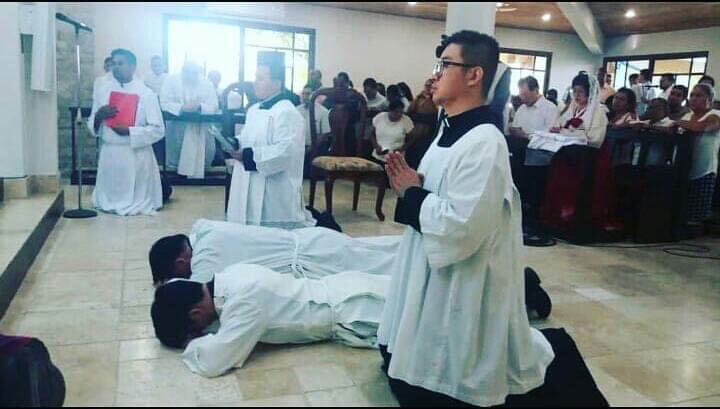
Ordination to the Diaconate of Two Korean Students
Yesterday was a big day in the seminary, especially for two young Korean men who were ordained as deacons to serve in Panama. These two men, known with Spanish names (Agustin and Pedro) here, are members of a Korean missionary congregation which has sent men to many parts of the world. Unlike Irish missionaries in former times who went abroad after ordination, these men are sent to the area in which they will be working for their formation and studies.
This system has a lot of advantages in that it means that they have a reasonable grasp of the local culture and are familiar with the local church that they are joining before they are ordained. At least, that is the hope. The two men ordained yesterday had a very difficult time with the language which made integrating a real challenge. Pedro made more progress with the language than Agustin but neither of them is entirely confident - hopefully, this will come with time.
Agustin is a past pupil of mine from the seminary here and I know from experience that his inability to speak Spanish severely limited his possibilities for participating in the classroom and for studying. Texts had to be sought out in Korea and, as none of the seminary staff speak Korean, there was no way of knowing what the Korean texts were like. I suppose it is really a question of everyone having done as much as they can - but it was a real challenge for all concerned.
They were ordained by the Archbishop of Panama City, Mons. Jose Domingo Ulloa, who is an Augustinian. During the homily (quite short for here, at 25 minutes) he spoke of the challenges that both had faced during their formation and of the fact that they would now face more challenges as they take up their roles in parish life.
Agustin's parents travelled for the ordination, Pedro's were unable to do so. In the photos below you can see the most beautiful traditional outfit that Agustin's mother wore to the celebration. Unfortunately, they couldn't understand word of what was going on but the fact that it was televised by a local religious TV channel will mean that they can get the recording and have things explained to them.
There is a Korean parish here and many people came from there and from the parishes that the two young men had worked in over their years as seminarians. It was a lovely celebration, quite simple really: and even though it took over 2 hours at the hottest part of the day, the air conditioning in the seminary chapel made it quite bearable.
Happy St. Patrick's Day to all - the feast is not celebrated here but I hope to meet up with some of my ex-students for something to eat to mark the occasion.


This system has a lot of advantages in that it means that they have a reasonable grasp of the local culture and are familiar with the local church that they are joining before they are ordained. At least, that is the hope. The two men ordained yesterday had a very difficult time with the language which made integrating a real challenge. Pedro made more progress with the language than Agustin but neither of them is entirely confident - hopefully, this will come with time.
Agustin is a past pupil of mine from the seminary here and I know from experience that his inability to speak Spanish severely limited his possibilities for participating in the classroom and for studying. Texts had to be sought out in Korea and, as none of the seminary staff speak Korean, there was no way of knowing what the Korean texts were like. I suppose it is really a question of everyone having done as much as they can - but it was a real challenge for all concerned.
They were ordained by the Archbishop of Panama City, Mons. Jose Domingo Ulloa, who is an Augustinian. During the homily (quite short for here, at 25 minutes) he spoke of the challenges that both had faced during their formation and of the fact that they would now face more challenges as they take up their roles in parish life.
Agustin's parents travelled for the ordination, Pedro's were unable to do so. In the photos below you can see the most beautiful traditional outfit that Agustin's mother wore to the celebration. Unfortunately, they couldn't understand word of what was going on but the fact that it was televised by a local religious TV channel will mean that they can get the recording and have things explained to them.
There is a Korean parish here and many people came from there and from the parishes that the two young men had worked in over their years as seminarians. It was a lovely celebration, quite simple really: and even though it took over 2 hours at the hottest part of the day, the air conditioning in the seminary chapel made it quite bearable.
Happy St. Patrick's Day to all - the feast is not celebrated here but I hope to meet up with some of my ex-students for something to eat to mark the occasion.


Friday, 15 March 2019
Numbers are dropping
Last night, at the Lay Institute, we had a very interesting discussion about the current state of the church in Panama. While churches here are generally full for Sunday Mass, they are not very large churches. It is likely that somewhere in the region of 20% attends Mass regularly but, of the other 80%, many never come at all - there are, of course, many who come occasionally or for special occasions.
This is a big concern for those who are active in church circles here. They can see, before their eyes, as it were, that numbers are dropping. Young people, while generally well-disposed towards the church, are not participating in the same way that their parents and grandparents did in the past.
There have never been huge numbers of priests in the Panamanian church but, with the work of the seminary progressing, there are several ordinations every year. However, the numbers in the seminary are dropping. This year there are under 40, spread over the 7 years of study. This is the lowest in quite a few years and this has meant that the theme of promoting vocations to the priesthood has taken on a renewed urgency.
It is noteworthy that the attitude to the idea of vocation is changing here. While up to a few years ago, the decision to enter the seminary was greeted with general goodwill and encouragement, now, the response is more muted. In fact, one of the lads who planned to enter the seminary this year had to pull out at the last minute because his mother (to put it mildly) wasn't very happy about it. Thankfully, that situation has now been resolved and the lad will go on to the seminary: whether that happens this year or next year remains to be decided by the "powers that be".
This is a big concern for those who are active in church circles here. They can see, before their eyes, as it were, that numbers are dropping. Young people, while generally well-disposed towards the church, are not participating in the same way that their parents and grandparents did in the past.
There have never been huge numbers of priests in the Panamanian church but, with the work of the seminary progressing, there are several ordinations every year. However, the numbers in the seminary are dropping. This year there are under 40, spread over the 7 years of study. This is the lowest in quite a few years and this has meant that the theme of promoting vocations to the priesthood has taken on a renewed urgency.
It is noteworthy that the attitude to the idea of vocation is changing here. While up to a few years ago, the decision to enter the seminary was greeted with general goodwill and encouragement, now, the response is more muted. In fact, one of the lads who planned to enter the seminary this year had to pull out at the last minute because his mother (to put it mildly) wasn't very happy about it. Thankfully, that situation has now been resolved and the lad will go on to the seminary: whether that happens this year or next year remains to be decided by the "powers that be".
Thursday, 14 March 2019
What am I actually doing?
At this stage of my visit here I can notice that things are getting much busier. Currently, I have 21 teaching hours a week plus the various bits and pieces that I am doing at the weekends, plus whatever else I am asked to do here in the seminary.
Last year, when I was here, I was asked to prepare to teach this year two courses: One on the Historical Jesus, and the other on Eschatology (theology of death, life after death, heaven and hell etc). I spent quite a bit of time preparing these courses: on the one hand, lessons must always be prepared; and, on the other hand, no matter how proficient one might be with the language, it is always wiser to have a prepared text, to avoid problems later.
I confirmed this arrangement twice with the seminary, to be sure that we were all on the same hymn sheet - all, however, to no avail. Despite all the planning, when I arrived here in February, I was asked to teach two completely different courses: One called Method in Theology and the other, The History of Theology. Neither of these are courses that I had prepared at all so, since I got here, I have been under pressure to prepare classes and structure the material. Unfortunately, this type of "planning" is not untypical here, in my experience.
Last night I began my lectures in the Lay Institute (INFAP - Institute for the Formation of Pastoral Agents) with a course called Introduction to Theology. I have taught this course before so that is ok but, it turns out, they have no teacher for this evening for a course on Jesus so I will now fill that slot: at least I can use the material I had prepared for use in the seminary but will not now be using.
I particularly enjoy teaching in the Lay Institute as it offers perspectives that are not to be found in the seminary. The students are mostly older than the seminarians, although some are a similar age; they are all either working full-time or else full-time university students (some are housewives); and they all bring a degree of experience to the study of theology that is very enriching.
Currently there are about 40 students, but this number is likely to rise. They are pretty evenly mixed gender-wise and are from a wide variety of backgrounds. The vast majority are coming to the lectures having already completed a full-day's work: this is a huge commitment. They come for a three hour lecture, twice a week which doesn't finish until 9pm. When you consider that most people here (me included) get up at 4.30am, not getting home until after 10pm makes it a very long day for them.
As well as the classes (in the seminary and in INFAP) I use the weekends (mostly) to give talks/ mini retreats on Saturdays, and help out in a parish on Sundays. I have two longer retreats coming up - one in the Augustinian parish which I was looking after recently while the friars were away on retreat, and another for the seminarians in the house where I am living.
A lot of the rest of the time is spent helping students with their course work/ essays/ theses or else hearing confessions, as well as being involved in the ordinary day-to-day life of the seminary.
All in all, the week is quite full but, having come such a long way, that is preferable to sitting around twiddling my thumbs.
Last year, when I was here, I was asked to prepare to teach this year two courses: One on the Historical Jesus, and the other on Eschatology (theology of death, life after death, heaven and hell etc). I spent quite a bit of time preparing these courses: on the one hand, lessons must always be prepared; and, on the other hand, no matter how proficient one might be with the language, it is always wiser to have a prepared text, to avoid problems later.
I confirmed this arrangement twice with the seminary, to be sure that we were all on the same hymn sheet - all, however, to no avail. Despite all the planning, when I arrived here in February, I was asked to teach two completely different courses: One called Method in Theology and the other, The History of Theology. Neither of these are courses that I had prepared at all so, since I got here, I have been under pressure to prepare classes and structure the material. Unfortunately, this type of "planning" is not untypical here, in my experience.
Last night I began my lectures in the Lay Institute (INFAP - Institute for the Formation of Pastoral Agents) with a course called Introduction to Theology. I have taught this course before so that is ok but, it turns out, they have no teacher for this evening for a course on Jesus so I will now fill that slot: at least I can use the material I had prepared for use in the seminary but will not now be using.
I particularly enjoy teaching in the Lay Institute as it offers perspectives that are not to be found in the seminary. The students are mostly older than the seminarians, although some are a similar age; they are all either working full-time or else full-time university students (some are housewives); and they all bring a degree of experience to the study of theology that is very enriching.
Currently there are about 40 students, but this number is likely to rise. They are pretty evenly mixed gender-wise and are from a wide variety of backgrounds. The vast majority are coming to the lectures having already completed a full-day's work: this is a huge commitment. They come for a three hour lecture, twice a week which doesn't finish until 9pm. When you consider that most people here (me included) get up at 4.30am, not getting home until after 10pm makes it a very long day for them.
As well as the classes (in the seminary and in INFAP) I use the weekends (mostly) to give talks/ mini retreats on Saturdays, and help out in a parish on Sundays. I have two longer retreats coming up - one in the Augustinian parish which I was looking after recently while the friars were away on retreat, and another for the seminarians in the house where I am living.
A lot of the rest of the time is spent helping students with their course work/ essays/ theses or else hearing confessions, as well as being involved in the ordinary day-to-day life of the seminary.
All in all, the week is quite full but, having come such a long way, that is preferable to sitting around twiddling my thumbs.
Tuesday, 12 March 2019
Graduation Day
 One of the things that I have been asked to do since I got here was to give what is called the
 Religious Invocation at a graduation ceremony in the Universidad Tecnica de Panama (The Technological University of Panama). While this is a totally secular university, there is a real openness to religion among the administration and college staff who acknowledge the importance of their graduates being formed with strong values. The chaplain, Fr. Justo, is a past pupil of mine and he needed help on the day so he asked me to step in.
Over 500 young people were graduating and they were accompanied by their families and guests so I'm guessing there must have been close on 2.000 people present for the ceremony. Always, at graduation ceremonies, there is a strong sense of both joy and hope - and so there should be. These young people have worked hard and graduating is a real achievement. In fact, this particular university has a very high reputation in Panama and its graduates are welcomed all over Central America.

This year, being an election year, there is a lot of talk about improving things in the country but, it has to be said, most people are at best sceptical about politicians, and, at worst, absolutely cynical. Unfortunately, the long history of official corruption (without any punishment of those involved) has created a situation in which politics is considered to be something, anything, other than public service. The young people at the graduation service will be voting, some of them for the first time - who knows what difference that young vote might make.

I was to speak for only a few minutes but it was striking to see, even with such a big crowd, how
attentive people were. I was the first speaker - there would be about 8 or 10 all together - so I discreetly withdrew and came home to the seminary: I would find it very difficult to sit in the blazing sun for what would be a ceremony that would, most likely, go on for over 4 hours.
Subscribe to:
Posts (Atom)